
Conversational Analytics: Chat With Your Data
Build a Conversational Analytics Solution Around Your Data, Business Logic, and Use Cases
Conversational analytics is changing how organizations interact with business data.
Instead of relying only on static dashboards, predefined reports, or analyst requests, the platform allows users to chat with their data in natural language and receive answers, visualizations, comparisons, forecasts, and deeper analysis directly from trusted business data.
But successful AI analytics requires more than simply adding an AI interface.
Cohesive DataOps helps organizations design and implement the system solutions built on clean data, reliable business logic, baseline dashboards, and AI-ready analytics infrastructure. In order to implement an AI business intelligence platform effectively, the system needs an AI-ready data source, a well-defined semantic layer, and governance that users can trust.
Whether you are evaluating Google Data Studio, Power BI Copilot, or one of many other AI analytics options, we help determine which approach best fits your data ecosystem, reporting needs, use cases, and budget.
See Conversational Analytics in Action
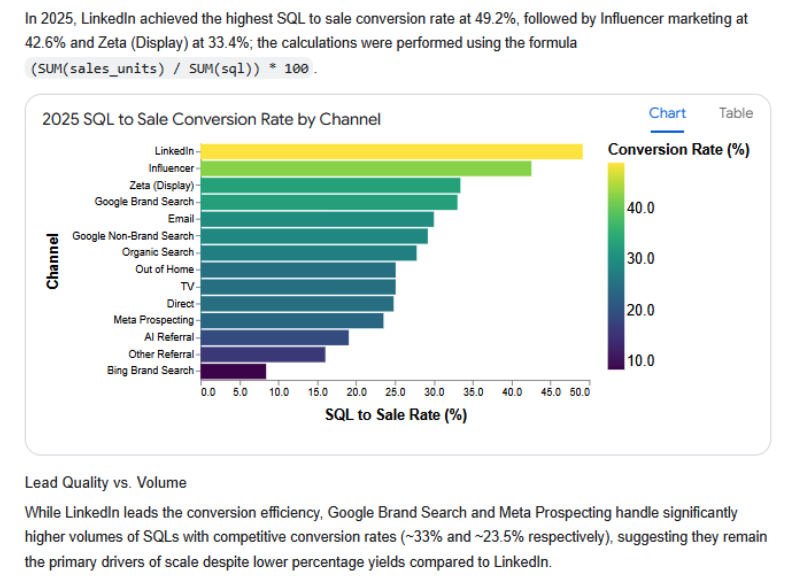
Ask: “Give me the breakdown of the SQL-to-sale rate by channel for 2025.” The response shows the calculation, a ranked chart, and a concise explanation of what the result means for lead quality and volume.

What Is Conversational Analytics?
Conversational analytics lets business users ask questions about their data in everyday language rather than relying only on dashboards, filters, SQL, or analyst-created reports. It is a self-service analytics experience that can turn a natural language query into an answer, visualization, comparison, forecast, or suggested follow-up question while still using the organization’s trusted definitions.
A user might ask why revenue declined, which channels have the strongest return, where leads are increasing but conversions are falling, or how performance compares with the same period last year.
The platform interprets the question, queries the approved data model, and returns an analytical response that may include charts, written insights, comparisons, or forecasts.
This creates a more dynamic workflow: dashboard to question, question to the analytics layer, and insight to decision.
- Why did revenue decline last month?
- Which markets are driving the change?
- What channels have the strongest return?
- Where are leads increasing but conversions falling?
- How does performance compare with the same period last year?
- What happens if media investment increases?
Conversational Analytics Extends Traditional BI
Traditional dashboards remain one of the best ways to monitor recurring KPIs, trends, and business performance. Conversational analytics adds another layer.
A dashboard may show that conversion has declined. AI analytics lets the user immediately ask why, which locations are driving the change, or which funnel stages weakened most.
Instead of creating a new report or dashboard page for every follow-up question, users can investigate the data dynamically. Dashboards show what is happening. Conversational analytics helps explain why it is happening.
Conversational Analytics Requires AI-Ready Data
One of the biggest misconceptions about conversational analytics is that AI eliminates the difficult work involved in analytics. It does not.
Conversational analytics makes it easier to ask questions of data. It does not automatically make the underlying data complete, accurate, connected, or trustworthy.
Marketing data may live across Google Ads, Meta, LinkedIn, GA4, and other platforms. Customer outcomes may live in a CRM. Revenue may live somewhere else. Campaigns, locations, products, customers, and lifecycle stages may all use different identifiers and naming conventions.
An AI analytics platform does not automatically know how those systems should relate. That business logic still has to be defined in the warehouse, the data model, or the semantic layer.
- Clean, continuously updated data pipelines
- Connected media, CRM, sales, revenue, and operational data
- Standardized dimensions and naming conventions
- Trusted KPI definitions
- Historical data normalization
- Correct relationships between data sources
- Attribution and business logic
- Appropriate aggregation and data grain
- Semantic models or AI-ready analytical tables
- Security, permissions, and governance
- Human validation of AI-generated results
AI lowers the cost of asking questions. It does not eliminate the work required to make the solution trustworthy.
Build a Data Foundation for Conversational Analytics
Cohesive DataOps can help build the complete analytics environment required to support both dashboards and conversational analytics.
- Source systems: media, web analytics, CRM, sales, revenue, customer data, and internal systems
- Data integration and transformation: APIs, ETL, data cleanup, historical mapping, and normalization
- AI-ready data warehouse: BigQuery, Azure, Snowflake, or another modern cloud warehouse
- Business logic and semantic modeling: relationships, KPIs, attribution, calculated measures, and security
- Analytics layer: dashboards, conversational analytics, and advanced AI analysis
The best conversational analytics architecture depends on how your existing data is structured, where your business logic lives, how complex your reporting environment is, and how users need to consume the results.
Choosing the Right Conversational Analytics Platform
There is no single conversational analytics platform that is best for every organization.
Some conversational analytics tools perform extremely well against clean, fully prepared analytical tables. Others can consume complex enterprise semantic models containing relationships, measures, calculations, and security logic.
Below are two examples we would currently highlight most often for clients, while recognizing they are only a few of many conversational analytics options in the market.
Google Data Studio Conversational Analytics
Accessible Conversational Analytics for AI-Ready Data
Google Data Studio provides a relatively accessible entry point into conversational analytics, particularly for organizations already using BigQuery and other Google data tools. A configured data agent can then use the prepared data and business context to answer common questions.
In our experience, Data Studio conversational analytics works particularly well when CRM, media, revenue, and other business data have already been transformed into clean analytical tables or fully joined flat datasets.
That architecture matters. Data Studio can work very well when the required joins and logic have already been resolved upstream in the warehouse. It is generally less suited to situations where the BI layer is expected to perform a large amount of relational modeling dynamically at query time.
For more complex questions, the underlying data may need to be aggregated or optimized into purpose-built analytical tables or pivots to improve performance and reduce query complexity. Some queries can time out when working from very large detailed tables.
The key takeaway is simple: the cleaner and more purpose-built the analytical dataset, the better the conversational analytics experience tends to be.
- Best fit: Organizations with well-prepared cloud data looking for an accessible conversational analytics solution
- Strengths: Low barrier to experimentation, natural-language Q&A, AI chart generator capabilities, narrative summaries, and straightforward exploratory analysis
- Key requirement: Clean, joined, optimized data structures in BigQuery or similar sources
Power BI Copilot for Conversational Analytics
Conversational Analytics Use Cases
Conversational Analytics on Top of Enterprise Semantic Models
Power BI Copilot offers a different advantage for conversational analytics. Rather than requiring all business logic to be flattened into a single analytical table, Copilot can work against an existing Power BI semantic model containing relationships, DAX measures, calculations, dimensions, and governed definitions.
This can be especially powerful for conversational analytics in complex environments such as multi-location businesses, franchise organizations, enterprise marketing reporting, and media-to-CRM-to-revenue analytics.
For organizations already invested in Microsoft’s ecosystem, Power BI conversational analytics can become another interface to an existing reporting environment rather than requiring a completely separate analytical architecture.
Results can appear right within the Power BI experience. Users can ask questions in Copilot and receive written responses, generated visuals, and analytical explanations tied to the semantic model that powers the report.
That makes Power BI especially attractive when a mature semantic layer already exists and the organization wants conversational analytics to extend the value of its governed enterprise BI environment.
- Best fit: Organizations with established Power BI environments, sophisticated semantic models, and complex enterprise reporting needs
- Strengths: Reuses governed business logic, supports enterprise reporting structures, and can surface results within Power BI
- Key requirement: A well-prepared semantic model and the right Microsoft licensing and capacity setup
Other conversational analytics platforms may also be relevant depending on the use case, including Tableau, ThoughtSpot, AI-native analytics tools, and more customized enterprise solutions. Our role is to help determine which platform path best fits the organization rather than pushing a one-size-fits-all platform choice.
Conversational Analytics Use Cases
Conversational Analytics for Reporting and Exploration
- Revenue
- Leads
- Sales
- Marketing performance
- Customer behavior
- Markets, locations, and products
Conversational Analytics for Diagnostic Analysis
- Performance changes
- Underperforming segments
- Anomalies
- Funnel leakage
- Market differences
- Channel trends
Conversational Analytics for Advanced Analysis
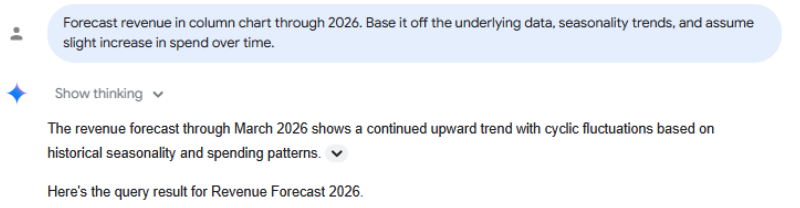
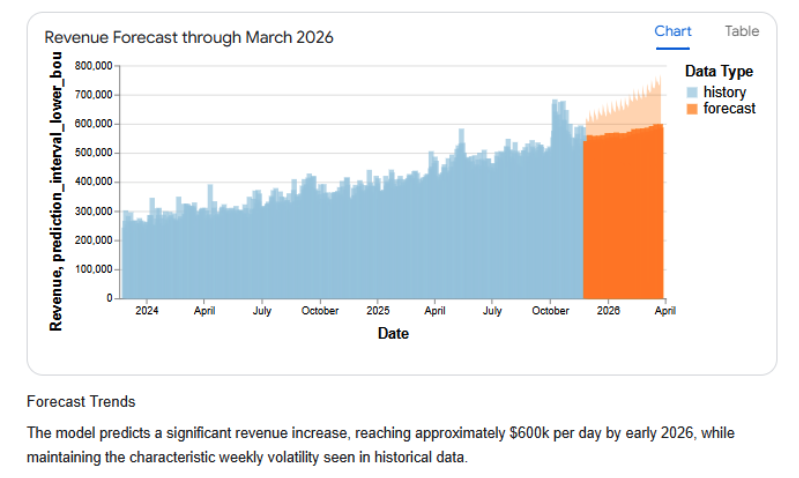
Forecasting With Conversational Analytics
Forecasting can be useful for planning when the historical data, seasonality, and assumptions are visible. It should be treated as an input to review and validation, not an automatic decision.
- Forecasts
- Scenario modeling
- Correlations
- Cross-channel relationships
- Halo effects
- Potential incrementality
Conversational Analytics for Executive and Client Reporting
- Dashboard visualizations
- Executive summaries
- Presentation-ready charts
- Recurring analytical views
- Client-facing insights
The right conversational analytics solution may combine several of these capabilities rather than relying on a single AI tool.
Where Conversational Analytics Works Best
AI analytics is particularly effective for trend analysis, period-over-period comparisons, KPI exploration, data visualization, variance investigation, exploratory analysis, and fast follow-up questions.
There are still areas where greater caution is required:
- Causality: Correlation does not automatically establish incrementality or MMM-quality measurement
- Complex business logic: The organization still needs agreed definitions for customer, lead, conversion, and revenue
- Forecasting: AI can generate forecasts quickly, but methodology and assumptions still need validation
- High-stakes decisions: Human review remains essential for financially or operationally important analysis
Conversational Analytics and AI Data Governance
As conversational analytics makes business data easier to access, governance becomes even more important.
The analytics layer needs to respect the same security and permission structures that govern the rest of the organization’s data environment.
A corporate user may be able to use conversational analytics across an entire organization, while a regional manager or franchise owner may only be permitted to analyze a subset of locations. The interface may be the same, but the underlying access should not be.
- User-level permissions
- Location-level access
- Row-level security
- Sensitive customer data restrictions
- Governed KPI definitions
- Approved data sources
- Trusted versus experimental measures
The Cost of Conversational Analytics Is More Than the AI License
One of the biggest changes in AI analytics is that AI functionality itself is becoming increasingly accessible. Some organizations can begin experimenting at very little incremental software cost. Others may extend an existing enterprise BI environment.
But the cost of the system should not be evaluated based only on software licensing. The valuable work often sits underneath the AI in data ingestion, warehouse architecture, historical cleanup, CRM normalization, marketing taxonomy, identity resolution, KPI definitions, semantic modeling, governance, validation, and custom business logic.
As conversational analytics technology becomes more widely available, these foundational capabilities become even more important.
Dashboards and Conversational Analytics Work Better Together
Conversational analytics does not eliminate the need for dashboards. Dashboards remain the fastest way to monitor standardized KPIs and recurring business performance. Conversational analytics complements them by helping users investigate why metrics are moving and what to do next.
From Conversational Analytics to Agentic Analytics
Today, most AI analytics workflows begin when a user asks a question. Future analytical agents will increasingly be able to monitor data, identify changes, investigate potential causes, and surface findings proactively. An AI data analyst can help investigate changes and surface findings, while AI-powered analytics can make those insights more accessible to business users.
Organizations building clean, governed, AI-ready conversational analytics environments today will be better positioned to adopt more advanced agentic analytics as those capabilities mature.
Get Started With Conversational Analytics
You do not need to choose between traditional dashboards and conversational analytics. And you do not need to rebuild your entire analytics ecosystem simply because new AI capabilities are available.
Cohesive DataOps can assess your current environment and help determine the right combination of:
- Data warehouse architecture
- Data integrations
- Data cleanup and normalization
- Business logic and semantic modeling
- Baseline BI dashboards
- Conversational analytics
- AI-assisted exploration
- Advanced analytics
- Governance
- Ongoing DataOps support
We work across modern analytics platforms and design conversational analytics solutions around your existing technology wherever practical. The right platform solution may involve Data Studio, Power BI, another platform, or a combination of technologies. Our focus is on matching the technology to the business problem.
FAQs
What is conversational analytics?
Conversational analytics lets people ask business questions in plain language and receive answers from approved data, often with charts, comparisons, and written context.
Can conversational analytics replace dashboards?
No. Dashboards are still best for monitoring recurring KPIs. Conversational analytics makes it easier to investigate changes and ask follow-up questions.
What data do we need before implementing conversational analytics?
You need AI-ready data: clean, connected, current data with agreed KPI definitions and reliable relationships between sources.
Can we ask questions across marketing, CRM, and revenue data?
Yes—when those sources are connected and modeled correctly. That makes it possible to trace performance from media investment through leads, sales, and revenue.
Do we need to replace our current BI platform?
Usually not. Conversational analytics can extend existing tools such as BigQuery, Looker, or Power BI when the data model and governance are ready.
How do you make AI-generated answers trustworthy?
Start with approved sources, clear metric definitions, permissions, and a specific question. Important results should be validated against the underlying data and business logic.
Can conversational analytics create charts?
Yes. Many platforms can generate charts from a question, but the visual is only as reliable as the data, calculation, and context behind it.
Can it handle forecasting or attribution questions?
It can support forecasting, scenario analysis, and cross-channel exploration. But correlation is not proof of incrementality, so important decisions still need an agreed method and human review.
How does AI data governance work?
The interface should respect the same row-level security, permissions, approved sources, and metric definitions used throughout your analytics environment.
What is the difference between a data agent and an AI data analyst?
A data agent is the configured interface that retrieves and analyzes governed data. An AI data analyst is a broader term for the tool or workflow that helps users explore and interpret it.
Ready to explore this capability? Cohesive DataOps can help evaluate your data ecosystem, reporting requirements, pain points, users, governance requirements, and budget — then design and implement the combination of baseline dashboards and the platform capabilities that best fits your organization.