
For decades, business intelligence has followed a familiar model: business users ask questions, analysts query the data, and dashboards deliver the answers.
AI is changing that model.
The emergence of the AI data analyst lets business users interact with their data directly, using natural language to ask questions, investigate trends, identify anomalies, and uncover insights.
But an AI data analyst is more than a chatbot connected to a database. The quality of its answers depends on the quality and context of the data behind it.
What Is an AI Data Analyst?
An AI data analyst is an AI-powered system that can interpret business questions, analyze data, and communicate insights in a way that business users can understand.
Instead of navigating multiple sales and marketing dashboards or submitting a request to an analyst, a user might ask:
“Why did our conversion rate decline last month?”
The system could identify the channels contributing to the decline, compare performance with previous periods, and provide a visualization or explanation. The user can then continue the conversation:
“Was the decline caused by lower lead volume or lead quality?”
This ability to ask follow-up questions is where conversational analytics becomes particularly powerful.
Explore Cohesive DataOps’ Conversational Analytics approach →
Conversational analytics provides the natural-language interface. An AI data analyst represents the broader analytical capability behind that interaction.
AI Needs More Than Data
Here is where organizations need to be careful.
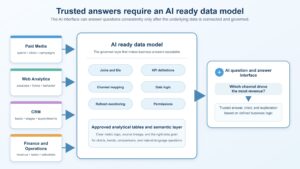
AI can make it easier to ask questions of your data. It cannot determine what your business means by “customer,” “revenue,” “conversion,” or “ROI” if those definitions have never been established.
Consider a simple question:
“Which marketing channel generated the most revenue?”
To answer it accurately, an AI system needs to understand your marketing data, CRM data, sales data, attribution methodology, revenue definitions, and the relationships between those systems.
That requires more than data access. It requires AI-ready data.
AI-ready data is clean, connected, consistently defined, and structured around the business logic that makes the information meaningful.
The Semantic Layer Is the Missing Link
This is where the semantic layer becomes critical.
A semantic layer translates complex underlying data into business concepts that both users and AI systems can understand. It establishes relationships, calculations, definitions, and rules around metrics and dimensions.
Without that context, an AI data analyst may produce an answer that sounds convincing but does not reflect how the business actually measures performance.
With it, AI can work from governed definitions and deliver more consistent, trustworthy analysis.
From Dashboards to AI Data Analysts
This does not mean dashboards or human analysts are going away.
Dashboards remain essential for monitoring standardized KPIs. Human analysts remain essential for complex analysis, strategic interpretation, experimentation, and business judgment.
The opportunity is to connect these capabilities.
Dashboards tell you what is happening. Conversational analytics helps you investigate why. AI data analysts can increasingly help you determine what to explore next.
That represents an important evolution in business intelligence.
But every step depends on the AI-readiness of the data beneath it.
The organizations that get the most value from AI analytics will not necessarily be those with the newest AI technology.
They will be those whose data is AI-Ready: clean, connected, governed, and supported by clearly defined business logic.