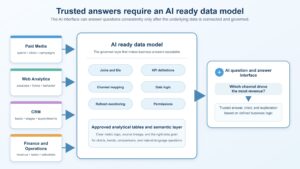

From AI-ready data and self-service business intelligence to the future of proactive, agentic analytics.
Imagine being able to ask your business data a question as easily as you would ask a colleague.
Which marketing channels generated the highest return on investment last quarter? Why are sales declining in a particular region? Are we on pace to meet our annual revenue targets? Where should we invest our next marketing dollar?
Historically, answering these questions often meant finding the right report, contacting a data analyst, navigating multiple dashboards or spending hours consolidating information from disparate systems.
Artificial intelligence is changing that experience.
Through conversational analytics, organizations can increasingly interact with their business data using natural language, making it possible to explore performance, uncover insights and make more informed decisions in a fraction of the time previously required.
But while the ability to have a conversation with your data may sound relatively straightforward, what happens behind the scenes is considerably more complex.
How do organizations ensure the answers they receive are accurate? What does it mean to have AI-ready data? Will conversational analytics replace traditional dashboards? How should businesses evaluate the growing number of AI-powered analytics platforms? And what does the future hold?
To explore these questions, Ty Velde, EVP, Client Operations at Cohesive DataOps sat down with Shane Kelly, EVP, Business Intelligence & Analytics at Cohesive DataOps, for an in-depth discussion about conversational analytics and its implications for businesses.
Drawing on extensive experience helping organizations integrate, manage, visualize and activate their business data, the conversation explores both the opportunities presented by conversational analytics and the foundational work necessary to realize its full potential.
WATCH: Welcome — A Discussion About Conversational Analytics
In This Article
- What Is Conversational Analytics?
- Moving Beyond the What to Understanding the Why
- Preparing Your Data for AI
- What Having AI-Ready Data Really Means
- Going Behind the Scenes With Conversational Analytics
- The Business Value of Conversational Analytics
- Democratizing Data Analysis
- Dashboards and Conversational Analytics
- Choosing the Right Conversational Analytics Platform
- Data Governance and Trust
- The Future of Conversational Analytics
- How Conversational Analytics Is Changing Business Decision-Making
- Frequently Asked Questions
What Is Conversational Analytics?
Conversational analytics is an AI-powered approach to business intelligence that enables users to interact with business data using natural language. Rather than relying exclusively on predefined reports, dashboards or technical queries, users can ask questions, explore trends and receive responses in the form of summaries, charts, tables and other visualizations.
Think of it as having a conversation with your business data.
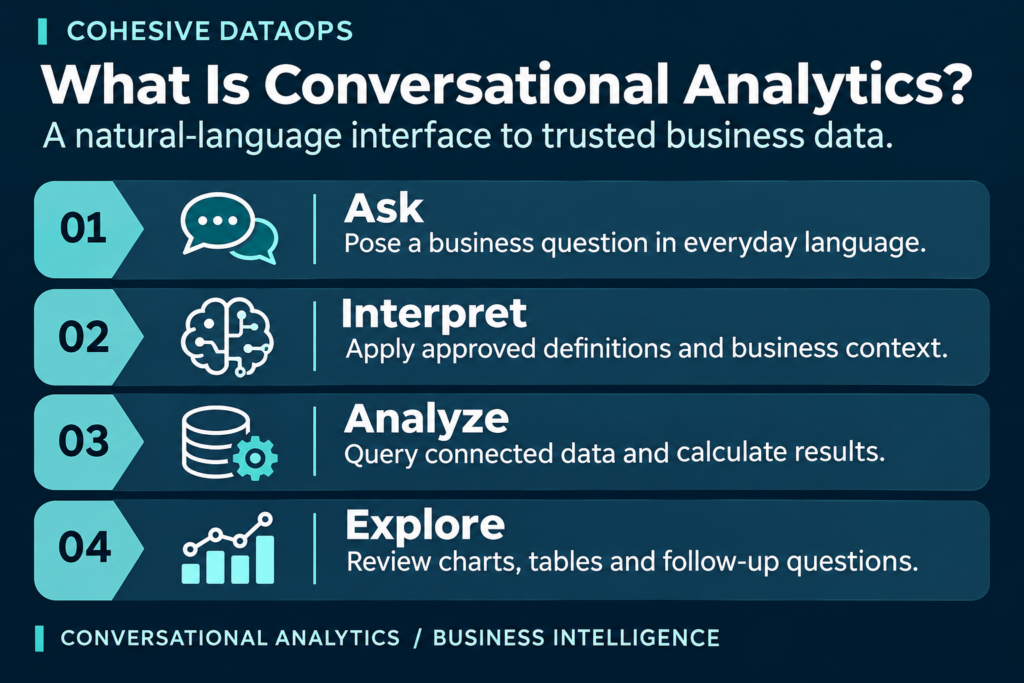
Instead of navigating multiple reports or having to understand how to write a database query, a business user can simply ask:
- How are my sales performing this month compared with last month?
- Which marketing channels are generating the most qualified leads?
- Are we on pace to meet our quarterly revenue targets?
- Which geographic markets are experiencing the greatest growth?
The user can then build on the initial response by asking follow-up questions, creating an interactive analytical experience.
WATCH: What Is Conversational Analytics?
While the experience may resemble interacting with a general-purpose AI chatbot, effective conversational analytics requires considerably more than simply uploading a spreadsheet.
“And it’s not really as simple as just upload a spreadsheet and trust whatever the chatbot says.”
— Shane Kelly, EVP, Business Intelligence & Analytics, Cohesive DataOps
To generate meaningful and reliable insights, conversational analytics platforms need access to trusted data, clearly defined metrics, established relationships between datasets and an understanding of the organization’s business logic.
When these foundations are in place, conversational analytics becomes a powerful complement to traditional business intelligence.
Moving Beyond the What to Understanding the Why
Traditional business intelligence dashboards are highly effective at helping organizations understand what is happening across their business.
They provide visibility into key performance indicators, historical trends and changes in performance.
However, identifying a change in performance often leads to a more important question: Why is it happening?
Conversational analytics can help accelerate that investigation.
WATCH: Moving Beyond the “What” to Understanding the “Why”
Exploring Business Performance Through Follow-Up Questions
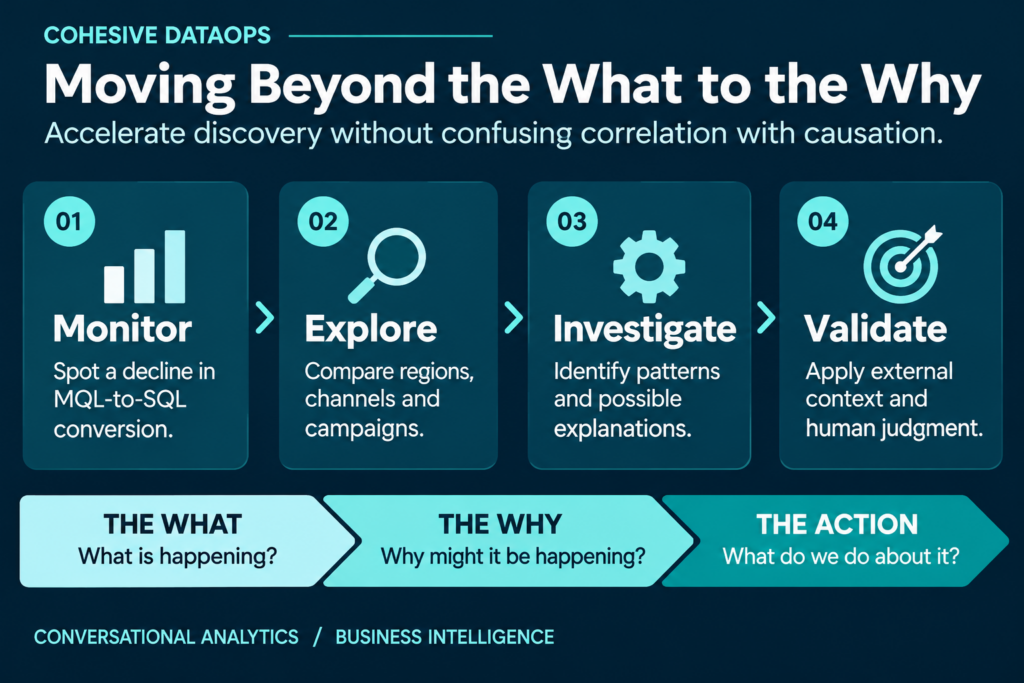
Consider a marketing organization that notices a decline in the percentage of marketing-qualified leads (MQLs) converting into sales-qualified leads (SQLs).
Traditionally, understanding the potential reasons behind that decline might require an analyst to extract additional data, create custom reports and explore multiple dimensions of performance.
With conversational analytics, a business user could begin by asking:
How has our MQL-to-SQL conversion rate changed over the past six months?
From there, the user could continue the investigation:
- Is the decline concentrated in specific geographic markets?
- Are certain marketing channels experiencing greater declines?
- Has the quality of organically generated leads changed?
- Are particular campaigns contributing disproportionately to the decline?
Each question builds on the preceding analysis, helping users explore potential explanations more efficiently.
Understanding the Difference Between Correlation and Causation
While conversational analytics can surface relationships and patterns within business data, identifying a correlation does not necessarily establish causation.
For example, an organization might discover that its Google Ads cost per click has increased significantly over the past year.
Conversational analytics can help identify which campaigns, keywords or geographic markets are contributing to that increase. However, external factors such as increased competition, changes in consumer demand or broader market conditions may also be influencing performance.
Unless the AI model has access to information about those factors, it may not be able to account for them.
The value of conversational analytics lies in accelerating discovery and helping organizations investigate potential explanations—not necessarily delivering definitive answers to every business question.
Human judgment and business context remain essential.
Preparing Your Data for AI
One of the biggest misconceptions surrounding conversational analytics is that implementing an AI-powered platform automatically makes an organization’s data ready for AI.
In reality, the effectiveness of conversational analytics depends heavily on the quality, structure and reliability of the underlying data environment.
WATCH: Preparing Your Data for AI
Consider an organization analyzing marketing and sales performance across Google Ads, Meta, LinkedIn and Salesforce.
Each platform may define and measure conversions differently.
One advertising platform may count a completed form submission as a conversion. Another may include phone calls or other website interactions. Meanwhile, Salesforce may track leads, qualified prospects and actual sales outcomes using entirely different definitions.
Without properly connecting these datasets and establishing consistent business rules, an AI-powered analytics platform may generate answers that appear compelling but are fundamentally inaccurate.
The Six Pillars of AI-Ready Data
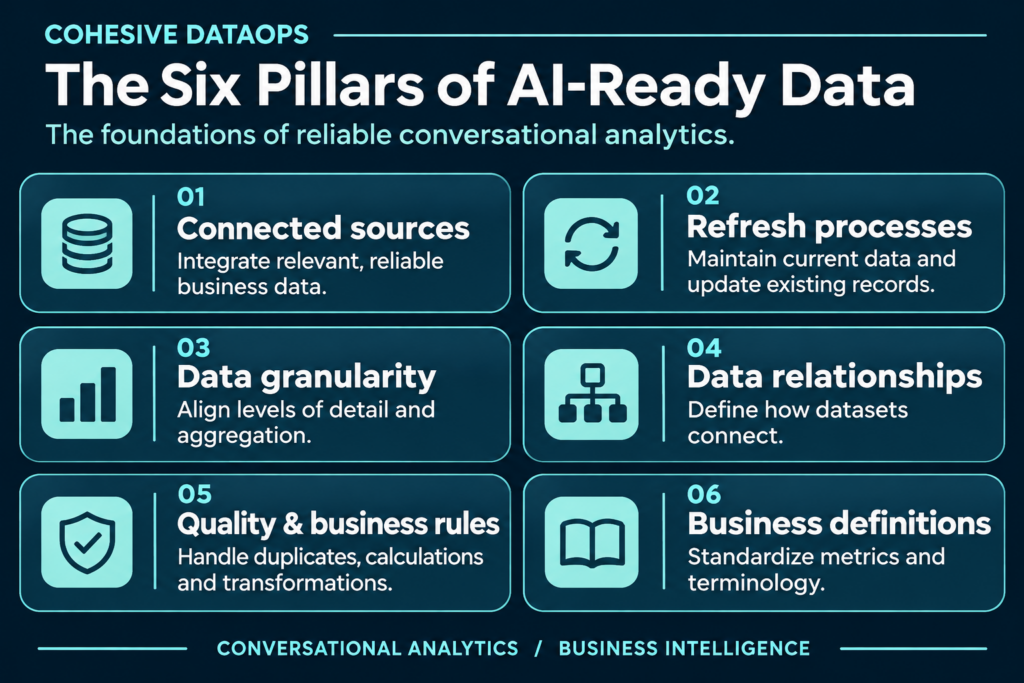
Organizations preparing their data for conversational analytics should consider six foundational areas.
- Connected and reliable data sources
- Relevant business data must be accessible and integrated across the systems necessary to support the organization’s analytical objectives.
- Consistent data refresh processes
- Organizations need reliable data refresh schedules that account for both newly generated information and changes to existing records.
- Appropriate data granularity
- Data must be structured at appropriate levels of detail, with a clear understanding of how information should be aggregated and compared.
- Clearly defined data relationships
- The relationships between datasets must be established so that information can be joined, blended and analyzed correctly.
- Data quality and business rules
- Processes for handling duplicate records, inconsistencies, transformations and calculated metrics must be clearly defined.
- Standardized business definitions
- The AI model must understand what individual metrics, fields and business terms mean within the context of the organization.
Becoming AI-Ready Doesn’t Necessarily Mean Starting Over
Preparing an organization for conversational analytics does not automatically require replacing its existing technology infrastructure or migrating all its data to a new platform.
Instead, organizations should begin by evaluating their existing data architecture, identifying gaps and determining what improvements are necessary to support reliable AI-powered analysis.
In many cases, the opportunity lies in improving and extending existing data infrastructure rather than rebuilding it entirely.
What Having AI-Ready Data Really Means
Having clean, connected and accessible data is an essential starting point. However, making data truly AI-ready also requires teaching AI how the business operates.
An AI platform needs to understand not only where information resides but also how that information should be interpreted.
WATCH: What Having AI-Ready Data Really Means
It’s About More Than the Numbers
During the discussion, Ty Velde summarizes this distinction:
“So basically it’s as much about the numbers as it is about the logic.”
— Ty Velde, EVP, Client Operations, Cohesive DataOps
Consider a business user asking:
How many SQLs did we generate last quarter?
The AI platform needs to understand that, within this particular business context, SQL refers to a sales-qualified lead rather than Structured Query Language.
It also needs to understand which data source contains that information, how sales-qualified leads are defined, which date fields should be used and whether any records should be excluded or deduplicated.
This business context can be established through a semantic layer, data models, metric definitions and persistent instructions that help AI interpret information consistently.
Connecting Data Across the Entire Customer Journey
The importance of these foundations becomes even more apparent when organizations attempt to answer more complex business questions.
For example:
Where should we invest our next marketing dollar?
Answering that question may require connecting information across the entire customer acquisition journey, including:
- Advertising spend
- Lead generation
- Lead qualification
- Sales pipeline
- Customer acquisition
- Revenue and profitability
Analyzing advertising data in isolation may reveal which campaigns generate the lowest cost per lead. However, those same campaigns may not produce the highest-quality customers or the greatest long-term business value.
By connecting information across the entire funnel, organizations can develop a more comprehensive understanding of marketing effectiveness.
The objective is not simply to make data available to AI. It is to provide AI with the information and business context necessary to support meaningful analysis.
Going Behind the Scenes With Conversational Analytics
What actually happens when a business user asks an AI-powered analytics platform a question?
While the user experience may appear simple, generating a reliable answer often involves multiple layers of data processing, interpretation and business logic.
WATCH: Going Behind the Scenes With Conversational Analytics
Imagine a Chief Marketing Officer of an Enterprise Tech B2B organization asking:
Which marketing channels generated the best return last quarter?
Before providing an answer, the analytics platform needs to understand what the organization means by return.
Is the business measuring:
- Total leads generated?
- Sales-qualified leads?
- Booked appointments?
- New customer acquisitions?
- Customer lifetime value?
- Revenue?
- Profitability?
Each definition could produce a substantially different answer.
Applying the Right Business Logic
The platform may also need to account for differences in data granularity, reporting periods, geographical markets, attribution methodologies and the timing of business outcomes.
For example, a prospective dental patient may click on an advertisement, schedule an appointment that same day and actually visit the practice several weeks later.
How should the resulting revenue be attributed to the original marketing activity?
What happens if the same individual interacts with multiple marketing channels before becoming a customer?
These questions highlight why organizations need consistent rules for attribution, deduplication, aggregation and performance measurement.
The Importance of Asking Better Questions
While a well-designed conversational analytics environment can incorporate approved business definitions and default instructions, users also need to understand how to formulate meaningful questions.
Providing additional context can improve the relevance of the resulting analysis.
Instead of asking which marketing channel performed best, a user might ask:
Which marketing channels generated the highest realized revenue from new customers relative to advertising spend last quarter?
The more specific question provides clearer analytical direction.
Even so, the channel with the highest historical return may not necessarily represent the best opportunity for additional investment.
Conversational analytics can inform the decision, but business leaders must continue to consider the broader context.
The Business Value of Conversational Analytics
While conversational analytics introduces new technological capabilities, its greatest value may lie in its ability to improve the speed and efficiency with which organizations turn data into actionable insights.
WATCH: The Business Value of Conversational Analytics
Imagine receiving an email from a client on Monday morning asking why marketing performance declined the previous week.
Historically, answering that question might require an analyst to extract data from multiple advertising platforms, consolidate information from a CRM system, build spreadsheets, create pivot tables and conduct several rounds of analysis.
Depending on the complexity of the question, that process could take a significant portion of the day.
With a properly configured conversational analytics environment, much of the preliminary investigation can potentially be completed far more efficiently.
Four Ways Conversational Analytics Creates Business Value
- Faster time to insight
- Business users can ask questions and explore follow-up analyses without waiting for every custom report to be created manually.
- Improved operational efficiency
- Organizations can reduce the time spent repeatedly extracting, consolidating and preparing data for routine analysis.
- Greater analytical independence
- Business users can explore performance more independently, reducing their reliance on technical specialists for every question.
- More proactive decision-making
- Faster access to relevant information creates opportunities to identify emerging issues and respond to changing business conditions sooner.
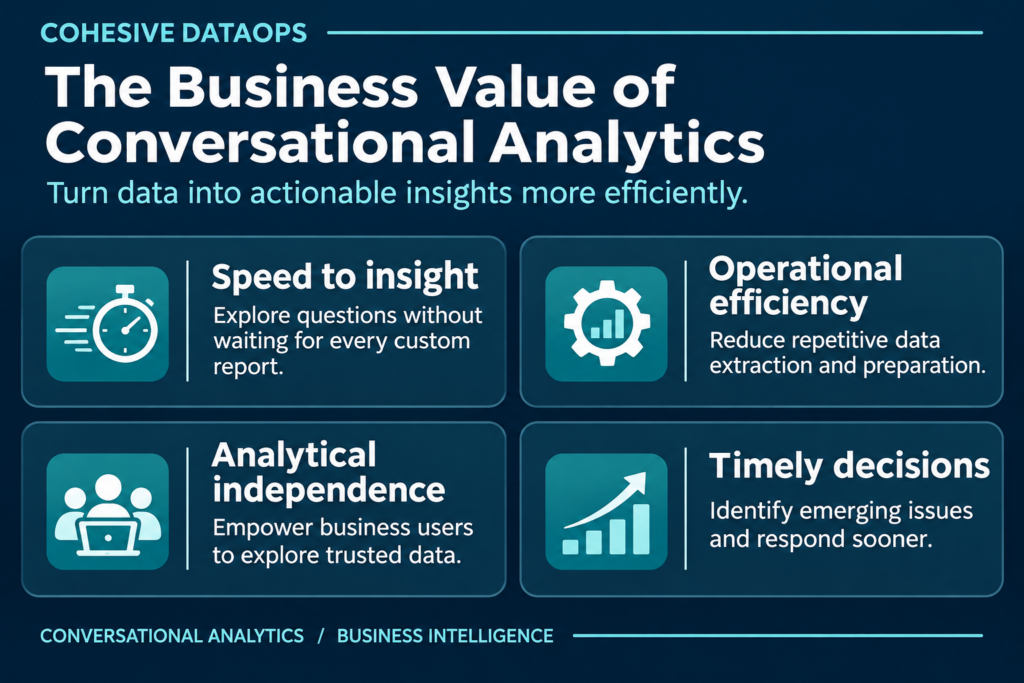
These capabilities can help organizations redirect time and resources away from routine data preparation and toward higher-value activities such as interpretation, strategic planning and business decision-making.
Democratizing Data Analysis
One of the most transformative aspects of conversational analytics is its potential to expand the number of people who can meaningfully interact with business data.
Historically, organizations have relied heavily on individuals with specialized analytical skills to generate reports, conduct investigations and answer complex business questions.
Even senior executives have often depended on analysts to provide additional information beyond what is readily available through traditional dashboards.
Conversational analytics is beginning to change that dynamic.
WATCH: Democratizing Data Analysis
From Passive Data Consumers to Active Participants
There is an important distinction between democratizing access to data and democratizing the ability to analyze it.
Making dashboards available across an organization provides visibility into business performance. Conversational analytics takes that a step further by enabling individuals to explore the information themselves.
Executives, managers and other business users can increasingly ask questions as they arise, investigate trends and explore potential explanations for changes in performance.
A chief marketing officer could investigate campaign effectiveness. A chief financial officer could explore revenue trends. An operations leader could examine performance across geographic markets.
Rather than simply consuming information, business users become active participants in the analytical process.
Will Conversational Analytics Replace Data Analysts and Data Scientists?
Not necessarily.
As Shane Kelly, EVP, Business Intelligence & Analytics, Cohesive DataOps explains:
“If you have a team of data scientists this does not replace them.”
Advanced statistical modeling, causal analysis, complex forecasting and other specialized analytical methodologies continue to require significant expertise.
Conversational analytics instead creates an opportunity to better align analytical resources with organizational needs.
Business users can independently explore routine questions, while data analysts and data scientists can devote more time to complex investigations and strategic analytical initiatives.
Ultimately, not everyone needs to become a data scientist for everyone to become more data-driven.
Dashboards and Conversational Analytics: Complementary, Not Competing Technologies
As conversational analytics becomes more sophisticated, organizations may question whether traditional dashboards will eventually become obsolete.
However, dashboards and conversational analytics serve different, complementary purposes.
WATCH: Dashboards and Conversational Analytics
Why Traditional Dashboards Still Matter
Organizations will continue to need consistent visibility into critical business metrics.
A marketing leader may want to monitor daily lead volume, advertising spend, customer acquisition costs and progress against monthly targets.
A finance team may need to monitor revenue, profitability and performance against budget.
These are metrics that stakeholders often want to access regularly without having to ask individual questions every time.
Traditional dashboards provide a consistent, efficient mechanism for monitoring business performance.
Conversational analytics provides an additional layer of exploration.
“It’s like having a built-in analyst on the sidebar of your dashboard.”
— Shane Kelly, Business Intelligence & Analytics, Cohesive DataOps
The Emergence of Hybrid Business Intelligence
Rather than replacing dashboards, conversational analytics can be integrated alongside them, creating a hybrid business intelligence experience.
In this environment, users can monitor their standard performance metrics and then use natural language to investigate areas requiring additional attention.
Insights uncovered through conversational analytics can, in turn, inform the development of new dashboard visualizations and reports.
This creates a continuous cycle of monitoring, exploration, discovery and refinement.
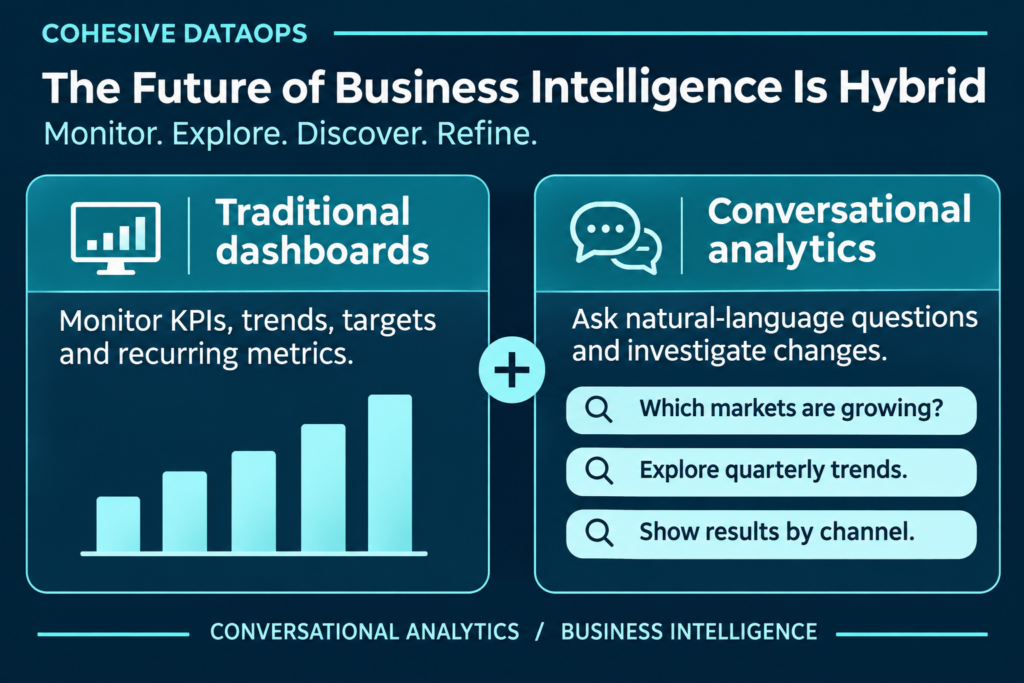
Traditional dashboards help organizations maintain visibility into business performance. Conversational analytics helps them better understand that performance.
Together, they create a more comprehensive and flexible business intelligence environment.
Choosing the Right Conversational Analytics Platform
As conversational analytics continues to evolve, a growing number of technology platforms are incorporating AI-powered analytical capabilities.
However, selecting the right platform is not a one-size-fits-all decision.
WATCH: Choosing the Right Platform
Start With Business Objectives, Not Technology
Before evaluating specific platforms, organizations should first understand what they want to accomplish.
Important considerations include:
- Business and analytical objectives
- Number and types of data sources
- Data volume and complexity
- Existing data and technology infrastructure
- Customization requirements
- Data governance and security needs
- Implementation and ongoing operating costs
A smaller e-commerce business with a manageable number of data sources may have significantly different requirements from a large enterprise managing millions of records across multiple geographic markets.
Exploring the Technology Landscape
Conversational analytics capabilities are available across a broad range of business intelligence and specialized AI platforms.
Google’s Data Studio may provide a starting point for organizations with relatively straightforward reporting environments, depending on their AI feature requirements and applicable licensing.
Organizations operating within the Microsoft ecosystem may want to explore Power BI and its Copilot capabilities.
Specialized conversational analytics platforms may offer additional flexibility, customization and integration with external data sources.
Some platforms, for example, can incorporate macroeconomic data to help organizations explore potential relationships between business performance and broader economic conditions.
The appropriate platform depends on the organization’s requirements rather than simply its size.
Understanding the Hidden Costs of AI
Beyond traditional software licensing, AI-powered analytics platforms can introduce additional operating expenses.
Depending on the platform, these may include charges associated with data processing, query volumes, token consumption, storage and other usage-based pricing mechanisms.
Understanding the total cost of ownership is essential, particularly as adoption increases across an organization.
Start Small, Learn and Scale
Organizations do not necessarily need to implement conversational analytics across every department from day one.
A practical starting point may involve identifying a focused business use case, connecting a manageable dataset and evaluating the resulting analytical experience.
This allows organizations to assess accuracy, usability, operating costs and business value before expanding to more complex applications.
The right platform is not necessarily the most sophisticated or expensive solution. It is the solution that best aligns with the organization’s data environment, business objectives and long-term strategy.
Data Governance and Trust
As conversational analytics makes business data easier to access, it also introduces important questions surrounding data governance, security and confidentiality.
How can organizations empower more employees to explore data while ensuring that sensitive information remains appropriately protected?
WATCH: Data Governance and Trust
Democratizing Data Does Not Mean Unrestricted Access
Organizations must establish clear policies governing who can access specific information and how that information can be used.
“You need to ensure that only the right people have access to the right things.”
— Shane Kelly, Business Intelligence & Analytics, Cohesive DataOps
This becomes particularly important when natural language interfaces allow users to explore information beyond the predefined metrics and visualizations available through traditional dashboards.
Applying Role-Based Access to Conversational Analytics
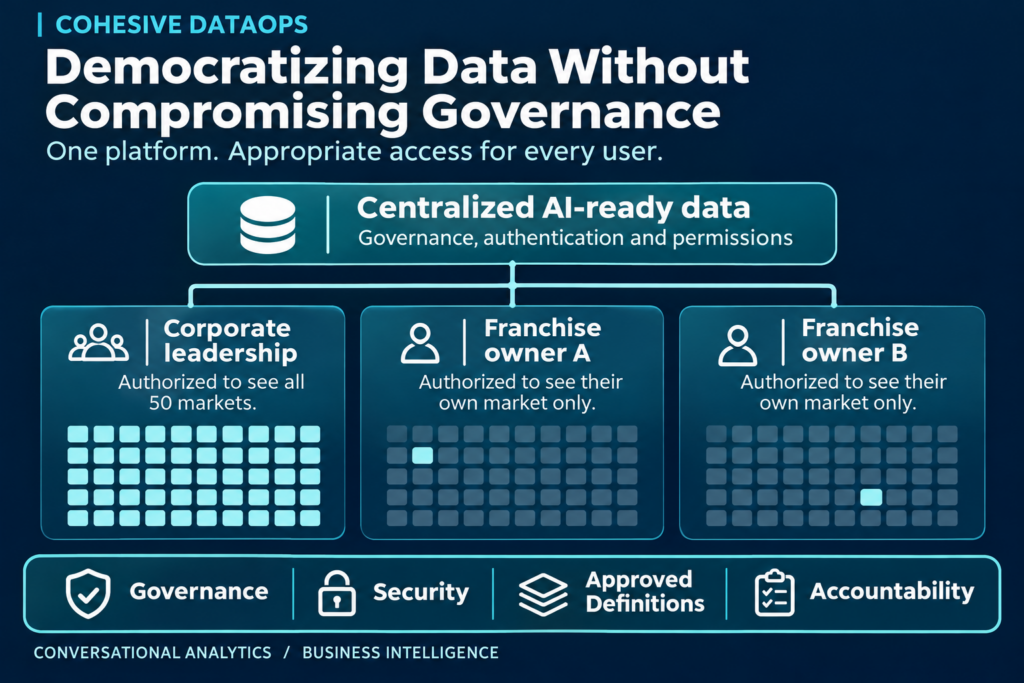
Consider a dental franchise organization operating across 50 geographic markets.
Corporate leadership may require visibility into marketing, sales and operational performance across all locations.
Individual franchise owners, however, may only need access to information related to their own markets.
With appropriately configured data access controls, both groups could potentially use the same business intelligence and conversational analytics environment while accessing different subsets of information.
The permissions that determine what users can see in dashboards should also be appropriately enforced when users interact with conversational analytics tools.
Making Governance Part of the Analytics Strategy
When implementing conversational analytics, organizations should evaluate capabilities such as individual user authentication, role-based access controls, row-level security, centralized permission management and auditability.
They should also validate that access restrictions are consistently enforced across AI-generated queries, results and downstream workflows.
Trust in conversational analytics extends beyond the accuracy of the information being generated. It also encompasses confidence that information is being accessed and shared appropriately.
The easier data becomes to access, the more important data governance becomes.
The Future of Conversational Analytics:
From Reactive Reporting to Proactive Intelligence
Is conversational analytics simply a better interface for interacting with business data, or does it represent a much larger shift in how organizations approach business intelligence?
While conversational analytics is already transforming how users explore information, emerging developments in agentic AI point toward an increasingly proactive analytics environment.
WATCH: Where Is Conversational Analytics Going?
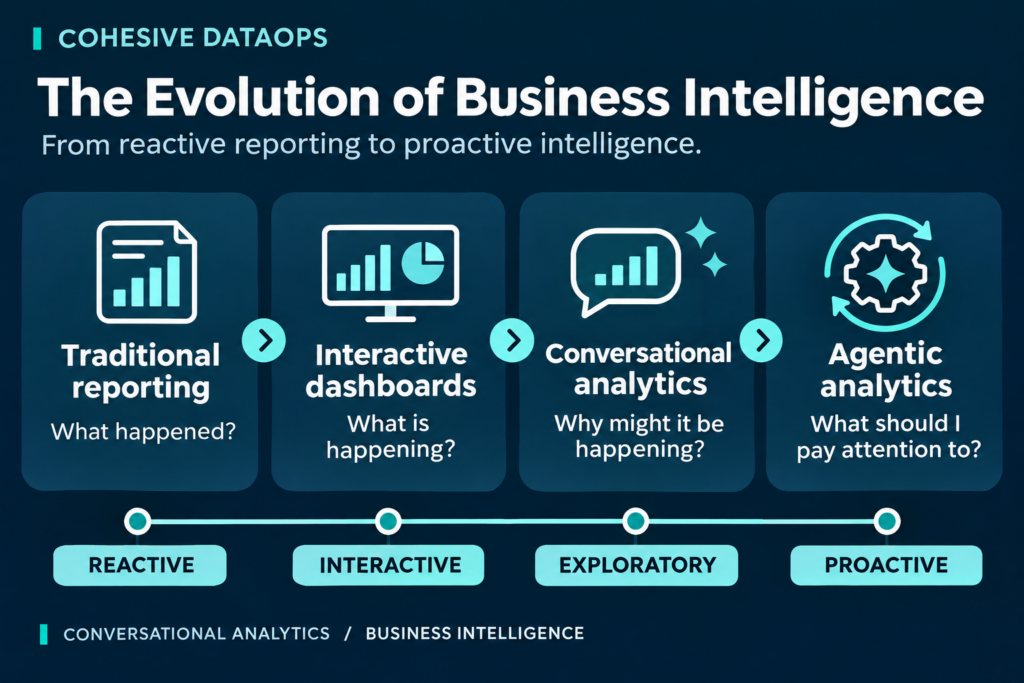
Moving Beyond Reactive Business Intelligence
Historically, much of business intelligence has been reactive.
A business leader reviews a dashboard, notices a change in performance and initiates an investigation.
Conversational analytics accelerates the investigation by making it easier to ask questions and explore potential explanations.
Agentic analytics introduces the possibility of initiating parts of that investigation automatically.
AI-powered systems connected to continuously refreshed business data may increasingly be able to monitor performance, identify anomalies, generate alerts and conduct preliminary investigations without waiting for a business user to initiate the process.
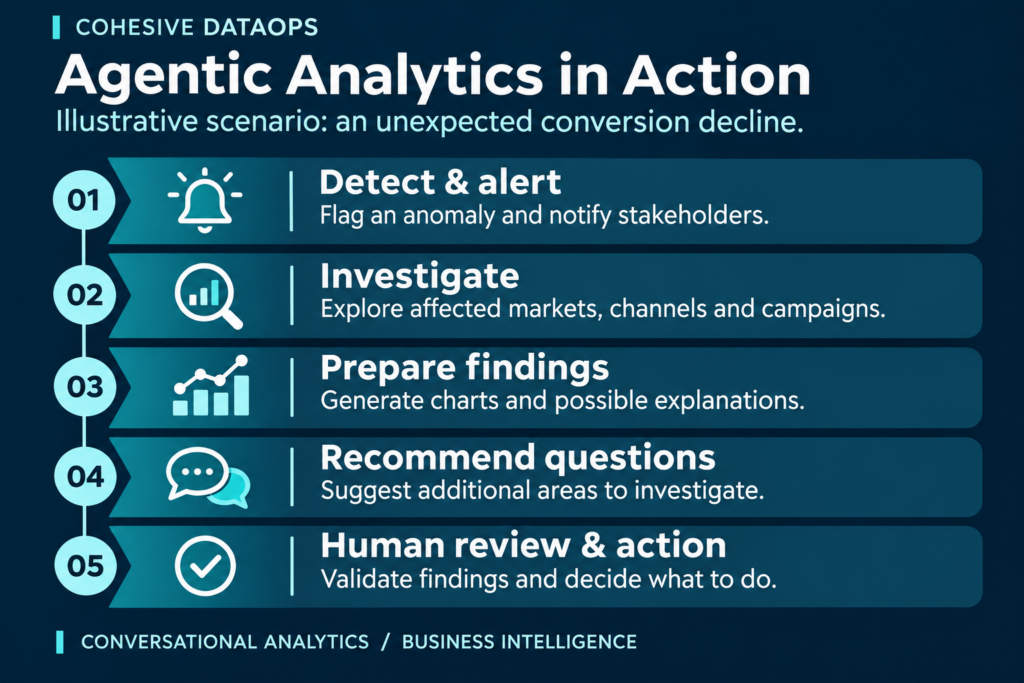
Agentic Analytics in Action
Imagine a marketing organization experiencing an unexpected decline in conversion volume.
An appropriately configured agentic analytics workflow could potentially:
- Identify a decline in conversions outside expected performance ranges.
- Notify relevant business stakeholders.
- Investigate which geographic markets are affected.
- Identify the channels and campaigns experiencing declines.
- Examine available information about recent changes in campaign activity or spending.
- Generate supporting charts and tables.
- Recommend questions for further investigation.
By the time a business leader begins investigating the issue, much of the preliminary analytical work could already be completed.
“It’s almost like having an automated analyst that goes in and that’s the first set of eyes to it and it’s digging into these things before you even realize that there’s a problem.”
— Shane Kelly, Business Intelligence & Analytics, Cohesive DataOps
Human Expertise Remains Essential
While agentic analytics can automate portions of an investigation, it cannot eliminate the need for human judgment.
AI systems remain limited by the information they can access and the business context they have been provided.
An AI agent may identify that advertising spend declined by 50% compared with the previous day. However, unless it has access to additional information, it may not know that the marketing agency intentionally reduced the budget.
Human expertise remains essential for validating findings, interpreting potential explanations and determining appropriate actions.
From Asking Better Questions to Knowing Which Questions to Ask
Perhaps the most significant opportunity presented by emerging analytics capabilities is their ability to help organizations discover questions they might not otherwise have considered.
As Shane Kelly, EVP, Business Intelligence & Analytics, Cohesive DataOps explains:
“Analytics can surface up the questions that you should be asking before you even know which questions to ask.”
The future of business intelligence may increasingly involve moving beyond monitoring what has already happened toward proactively identifying what deserves attention.
How Conversational Analytics Is Changing the Future of Business Decision-Making
For decades, getting answers to business questions often meant finding the right report, contacting the right person or waiting for someone to complete an analysis.
Conversational analytics is changing that experience.
Organizations now have an opportunity to make data analysis more accessible, more interactive and more closely integrated into everyday business workflows.
WATCH: How the Future Is Changing
However, the ability to generate answers more quickly does not guarantee that those answers are correct.
AI Will Not Fix Bad Data
As Shane Kelly, EVP, Business Intelligence & Analytics, Cohesive DataOps cautions: “AI is not going to fix bad data.”
Inconsistent definitions, improperly joined datasets, incomplete business logic and inaccurate assumptions can all result in misleading AI-generated insights.
One of the greatest risks is that these insights may be presented in a polished, professional and seemingly credible format.
An impressive visualization or confidently articulated response does not necessarily mean that the analysis is accurate.
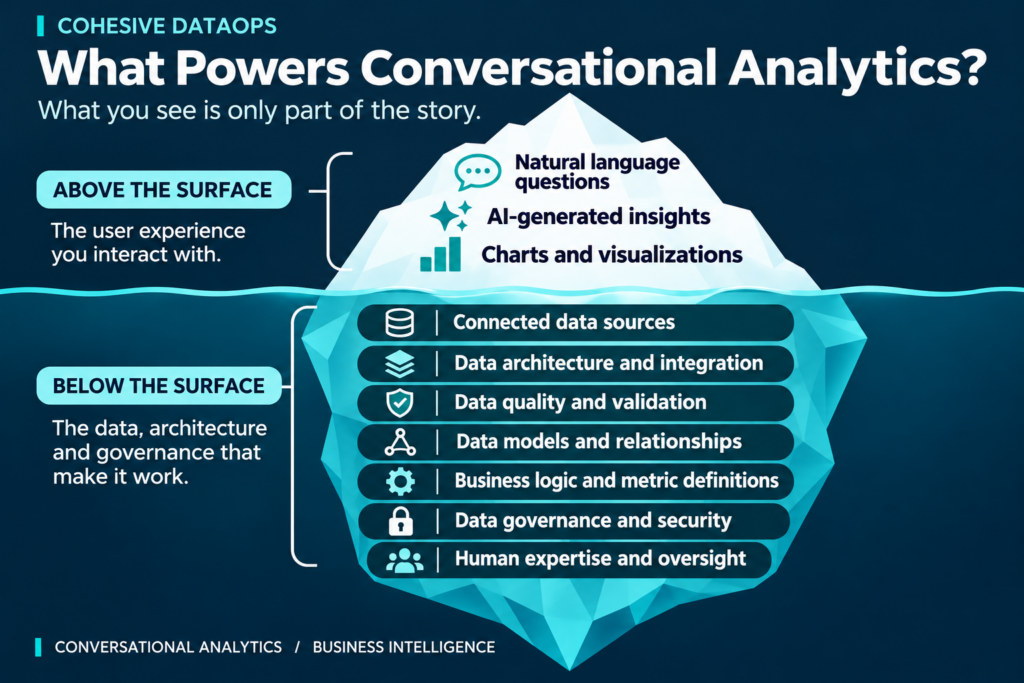
This is why the work that happens beneath the surface of a conversational analytics environment is so important.
The Real Competitive Advantage Is Trusted Data
As conversational analytics platforms become more widely available, competitive advantage may increasingly come from an organization’s ability to effectively leverage these technologies.
Organizations that have invested in reliable data infrastructure, integrated data sources, consistent business definitions, effective governance and analytical expertise will be better positioned to realize the value of emerging AI capabilities.
Conversational analytics is not simply a technology initiative. It is an opportunity to rethink how an organization interacts with information and incorporates data into its decision-making processes.
Ultimately, the goal is not simply to get more answers or get answers faster.
It is to make better business decisions.
WATCH: An In-Depth Conversation about Conversational Analytics – The Full Length, End to End Interview with Ty Velde & Shane Kelly of Cohesive DataOps
Frequently Asked Questions About Conversational Analytics
What is conversational analytics?
Conversational analytics is an AI-powered approach to business intelligence that allows users to interact with business data using natural language. Users can ask questions, explore performance trends and receive responses through summaries, charts, tables and other analytical outputs.
How is conversational analytics different from traditional business intelligence?
Traditional business intelligence typically relies on predefined reports, dashboards and analytical workflows. Conversational analytics enables users to explore business data more dynamically by asking questions and conducting follow-up investigations using natural language.
The two approaches complement one another.
What is AI-ready data?
AI-ready data is data that is appropriately connected, structured, reliable, governed and enriched with the business context necessary for artificial intelligence systems to interpret and analyze it effectively.
This includes clearly defined metrics, established data relationships, consistent refresh processes and documented business logic.
Will conversational analytics replace dashboards?
Conversational analytics is unlikely to eliminate the need for traditional dashboards. Dashboards provide consistent visibility into key business metrics, while conversational analytics enables more flexible, on-demand investigations.
Together, they support a hybrid business intelligence experience.
Will conversational analytics replace data analysts and data scientists?
Conversational analytics can reduce the time spent on routine reporting and preliminary analysis. However, advanced statistical modeling, complex data science techniques, validation and strategic business interpretation continue to require specialized expertise.
What are the primary business benefits of conversational analytics?
Potential benefits include faster access to insights, improved operational efficiency, greater analytical independence, broader participation in data analysis and more timely business decision-making.
Is conversational analytics only for large enterprises?
No. Conversational analytics can support organizations of varying sizes. The appropriate technology depends on business objectives, data complexity, governance requirements, available resources and budget.
Organizations can begin with a focused use case and expand as their requirements evolve.
What are the risks of conversational analytics?
Potential risks include inaccurate answers caused by poor data quality, inconsistent metric definitions, incorrect data relationships, inadequate security controls, ambiguous user questions and excessive reliance on AI-generated conclusions.
Trusted data foundations, effective governance and human oversight are essential to managing these risks.
What is agentic analytics?
Agentic analytics refers to the use of AI agents to automate aspects of analytical workflows, such as monitoring performance, detecting anomalies, conducting preliminary investigations and recommending follow-up questions.
It introduces opportunities for businesses to move from reactive reporting toward more proactive intelligence.
How can organizations get started with conversational analytics?
Organizations should begin by identifying a high-value business use case, evaluating their existing data infrastructure, addressing gaps in data readiness and selecting a platform appropriate for their requirements.
Starting with a focused implementation can help organizations validate business value before expanding their capabilities.
Is Your Organization Ready for Conversational Analytics?
Conversational analytics is transforming the way businesses interact with data. Unlocking its full potential, however, requires more than adopting an AI-powered platform.
It requires a trusted data foundation.
At Cohesive DataOps, we help organizations connect, manage, transform and activate their business data to support more effective analytics and informed decision-making.
Whether your organization is just beginning to explore conversational analytics, evaluating its AI readiness or looking to evolve its existing business intelligence capabilities, establishing the right foundation is essential.
Let’s explore how your organization can bridge the gap between its existing data environment and the emerging possibilities of AI-powered analytics.
Better Data. Better Questions. Better Insights. Better Business Decisions.
About the Experts
Shane Kelly — Executive Vice President, Business Intelligence & Analytics, Cohesive DataOps
Shane brings extensive experience working with organizations to integrate complex data sources, develop business intelligence solutions and transform data into meaningful, actionable insights. His background includes working with major organizations and supporting analytics initiatives across marketing and business performance.
Ty Velde — EVP, Client Operations, Cohesive DataOps
Ty leads this thought leadership discussion exploring the business implications of conversational analytics, the importance of AI-ready data and the evolving role of artificial intelligence in organizational decision-making.